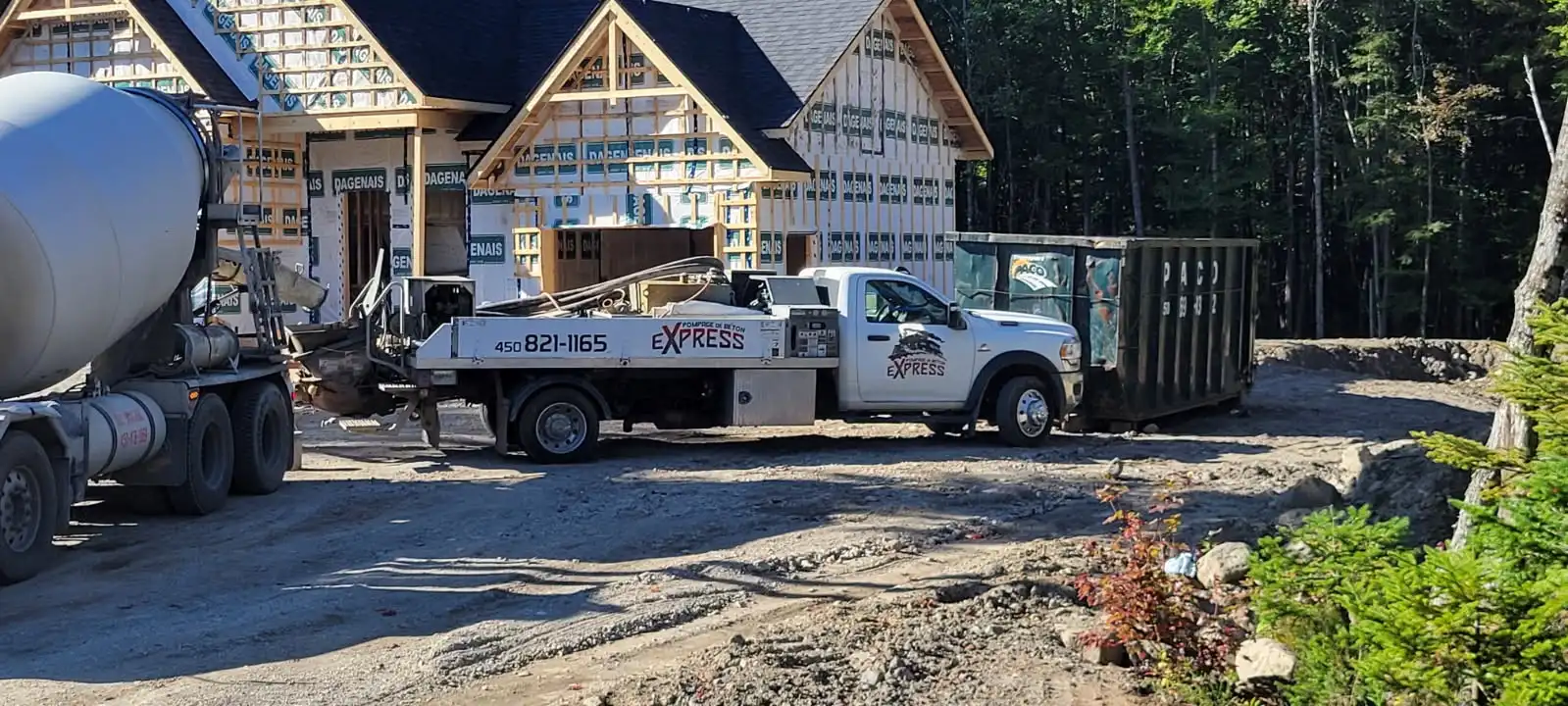
Concrete Farm Road: Line Pump, Pouring Sequence, Ground and Weather
A concrete farm road often links buildings, a feeding area or a storage pad set well back from the public road. Mixer trucks, meanwhile, are happier on gravel.
From Mascouche to Rivière-Rouge, Pompage de Béton Express takes on farm lanes and agricultural paving. Below, you'll see how a long pumping job in the middle of a farm gets planned.
Farm Road Pours: Four Early Decisions
They are made early on, with your contractor and our team.
A Pipeline on the Ground
It grows longer along the route; only the pipes cross the soft ground between the yard and the work.
Panel Order
Pouring starts at the farthest end and backs toward the pump, never crossing fresh concrete.
A Compacted Base
The gravel under the slab is placed and compacted according to the plans, then checked ahead of time.
Watch the Weather
Rain, frost, heat or wind: the date is confirmed based on the forecast and the state of the access lanes.
Why a Line Pump Suits Long Layouts
On a farm, the work is rarely right by the road. A lane to the silo, an alley between two buildings, an exercise yard or a wash area may sit behind the barns, past soft ground or up a slope.
The line pump goes where the ground is solid, near the entrance or the yard. Its pipeline, added section after section, follows the route out to the last panel of the job. The mixer trucks all empty their loads in one place, without sinking into the field or damaging the prepared gravel.
On a large surface, the pipeline can also be swung in a fan pattern to cover the panels one by one. Its route is decided in advance: it runs along the edge of the work, goes around corners and must never rest on a finished section.
For a small area within reach of a firm spot, a boom of 28 to 42 metres can do the job without any pipeline on the ground. Other projects that are possible on a farm are described under agricultural pumping.
In Short
When a farm road or a large surface sits far from the road, the line pump stays near the entrance and its pipeline follows the route as far as needed. Panel by panel, the crew retreats toward the pump over a compacted base, and the date is confirmed based on the weather. Pompage de Béton Express helps you plan where the pipes run and where the trucks will stand.
When the Boom Takes Over
Not every farm project needs a pipeline on the ground. A concrete pad next to a building, a feeding area behind the barn or an access ramp may be within reach of a solid spot for the truck.
In that case, the boom swings out above the forms and places the concrete with no pipes to assemble or take apart. It also reaches over a fence, a ditch or a hedge.
The choice comes down to three things:
- how far the truck sits from the farthest point that needs concrete;
- room to deploy the outriggers on ground that can carry the load;
- branches and power lines above the site, which dispatch needs to know about.
Near power lines, the eco-track system on our booms makes the manoeuvre safer. To see which booms are available, check the table on our fleet page.

Ground, Joints and Weather: Getting Ready for a Long Job
A farm lane carries heavy loads: tractors, manure spreaders, milk or grain trucks. Its design is up to your engineer or contractor: thickness, rebar, joints, gravel base and drainage are on the plans. Frost heave and spring thaw, a big factor in Quebec, are part of what they assess.
Before pumping begins, the base needs to be compacted, levelled and without puddles. In cold weather, ask your contractor how the ground and the concrete will be protected.
On the day, keep everyone on the farm informed: the section being poured and the pipeline area are closed to tractors. Plan another way to reach the buildings until your contractor reopens the lane.
| Condition | What It Changes |
|---|---|
| Rain the day before | Softer access for the mixer trucks, base to be checked |
| Rain during pumping | Harder finishing, decision left to the finishers |
| Heat and wind | Surface dries fast, more finishers or an earlier start |
| Cold | Concrete protected as set out in the specifications |
| Spring thaw | Soft lanes on the farm; allowed loads may be reduced on some roads, so check before setting the date |
Farm Road: Frequently Asked Questions
Can a long farm road be finished in a single session?
A short stretch, yes; a long lane is often poured in several sections, based on the joint layout in the drawings and the finishers' capacity. Each section begins at its farthest point and finishes next to the pump. Your contractor works out the split; then it's just a matter of setting a date for each section.
Can the pipeline cross a ditch or a fence?
Generally, yes: the pipeline can be laid across a ditch, slipped under a fence or run along a building, as long as it stays stable and reachable. Mention these obstacles in your request. Keep it away from tractor crossings: no vehicle should drive over it during pumping.
Does a concrete lane need plans?
It's strongly recommended. A lane used by tractors and heavy trucks has to be designed for those loads, and for frost. Your engineer or contractor sets the thickness, rebar and joints; also ask the municipality whether the work affects a ditch or a watercourse.
What happens if it starts raining mid-job?
It depends on how hard it rains and how far along the work is. The finishing crew decides whether to protect the surface and keep going or to stop at a planned joint. To avoid that situation, confirm the date with dispatch after checking the forecast.
Can an exercise yard or a pad be poured at the same time?
It can be done once every form is built and the total volume is known. The pipeline can be shifted from one surface to the next, or the boom covers the closest area. List every surface in the form so your quote covers everything.
Farm Lane or Large Surface: Get a Quote
Share an estimate of the route's length, how it connects to the road and your ideal date. Pompage de Béton Express also takes calls at dispatch: 450-821-1165.