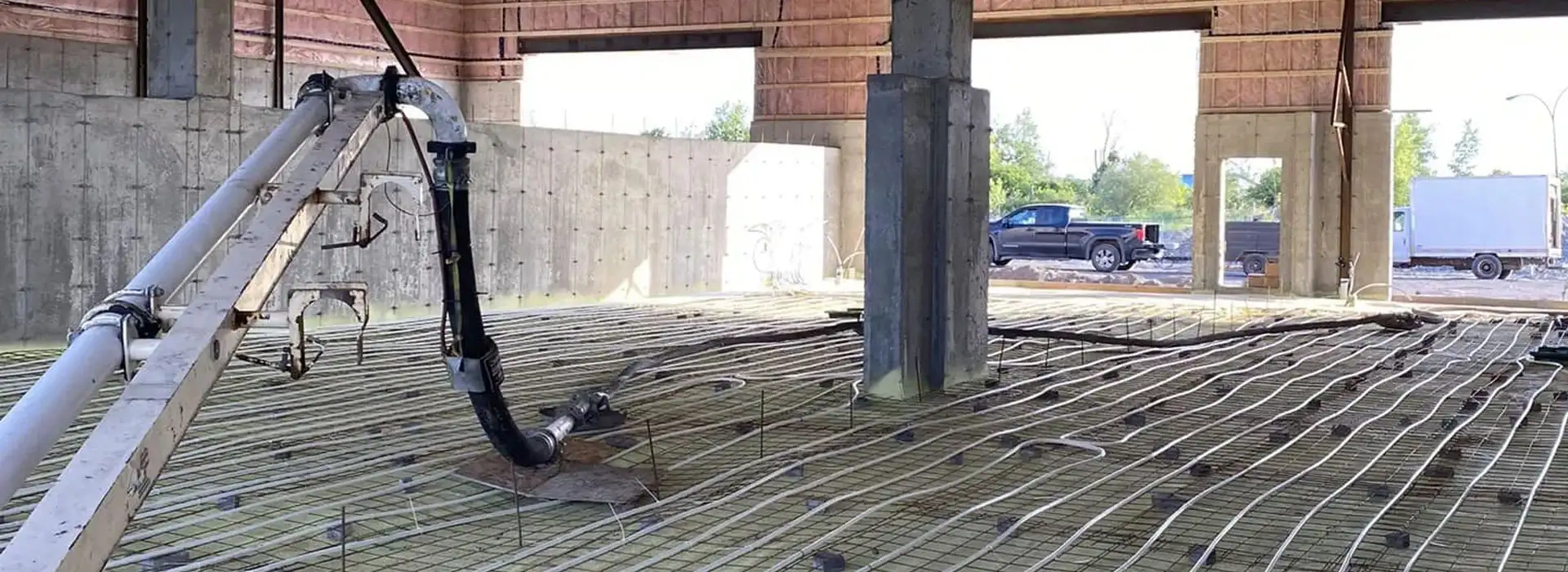
Commercial Concrete Floor: Planning a Large Pumping Day
Pouring the concrete floor of a warehouse, a store or a building with radiant heating calls for a clear plan: the area is large, fresh concrete does not wait, and the finishers have to keep up.
Pompage de Béton Express pumps this kind of slab from Laval to the Laurentians. Here is how to prepare the pace, the pouring order and the coordination with your contractor.
Four Decisions to Make Before Pouring Day
What gets settled with the general contractor well before the pump truck shows up.
Divide the Area
Split the floor into zones that follow the joints in the specs, so each one can be finished the same day.
Set the Pace
Space out deliveries to keep the hopper fed without mixer trucks lining up on the street.
Protect the Tubing
On a radiant floor, have the tubing tested and plan where the hose and the workers will move.
Name One Contact
One person talks to the operator and to dispatch while pouring, so messages do not get crossed.
A Pace Built Around the Finishers
On a large floor, the pump is rarely what limits the day. What counts is the area the finishers can spread, level and trowel before the concrete starts to set. So the pace is worked out from their number and their method first, then back to the deliveries.
While pouring, the operator adjusts the pumping to the finishers' speed. The concrete still has to show up at the right moment, neither too early nor too late.
A few pointers to avoid stoppages:
- schedule deliveries at a steady interval, adjusted as the work progresses;
- give one person the job of tracking the trucks, with the authority to slow down or speed up the next loads;
- do not let a mixer truck wait too long: concrete loses workability in the drum;
- watch the weather: heat speeds up setting, sun and wind dry out the surface, cold slows everything down.
A long stop in the middle of a zone can leave a cold joint, a seam nobody had planned for.
In Short
To pump a large concrete floor, start from the pace the finishers can hold, divide the area into zones according to the specs, and space out deliveries so the hopper is never left empty. Pouring begins at the point farthest from the pump and works back toward it. Pompage de Béton Express agrees with your contractor ahead of time on the truck's position, the mixer trucks' route and the start time.
In What Order Should the Area Be Poured?
Pouring generally starts at the back of the area, far from the pump, and works its way toward it. That way, nobody has to cross fresh concrete to retreat, and the hose never drags across a zone that is already finished.
With a boom pump, the truck is positioned to cover as much of the floor as possible from one spot; if the floor goes beyond its reach, a move between two zones is planned ahead. With a line pump, the pipeline is run to the back of the area, then shortened section by section as placement retreats.
Between zones, the boundary follows the joints set by the designer. In a large warehouse or a neighbourhood retail unit, that layout decides what time the last zone wraps up. The other work we pump on these sites is listed on our commercial page.

Warehouse, Store or Radiant Floor: What Changes
| Type of floor | Common constraint | What to plan |
|---|---|---|
| Warehouse | Very large area, often under a roof that is already closed in | Pipeline route through a loading door, pouring zones, ventilation if engines run near the doors |
| Store | Narrow unit, neighbours open for business, shared parking lot | Start time, where the trucks go, protection of existing finishes |
| Radiant floor | Heating tubes fastened beneath the concrete | Tubing test, protected walkways, joints laid out with the tube layout in mind |
The radiant floor calls for the most care. Before the pump arrives, have the heating installer check the tubing for leaks, and ask whether it should stay under pressure while pouring.
During placement, the end of the hose stays close to the surface: concrete should not drop from high up onto the tubes. Lay down planks so people can move around without crushing the loops.
Finally, mark the tube layout on a plan: the saw cuts for control joints have to take it into account. Your designer or installer sets those positions, following the system manufacturer's instructions.
Pouring a Concrete Floor: Frequently Asked Questions
How much area can be poured in a day?
No figure fits every site: it depends on the number of finishers, the weather, the finish required and the pace of deliveries. The pump keeps up, so it is the size of the finishing crew that sets the size of each zone. Fill out the form with the floor's dimensions and we will talk it through with you.
Boom or line pump for a warehouse floor?
A boom works well when the floor is open from above and the truck can park close by. When the building is already roofed, the pipeline of a line pump can enter through a wide opening. The site assessment decides; our guide on choosing a boom pump or line pump compares the two.
Does a closed building rule out pumping?
Not necessarily. Pump truck and mixers alike stay outside, and the pipeline enters by way of a doorway. Plan good ventilation if engines run near the openings, enough light for the finishers, and protection for walls and door frames wherever the pipeline runs.
What if a concrete delivery runs late?
Let the site contact know right away: placement can be eased while the next truck arrives, but a long gap risks a cold joint. Agree beforehand, with your designer, on where a zone could be stopped cleanly if the delay drags on.
Where is the pump washed out afterwards?
The pump truck is cleaned on site once pumping is done, and the rinse water carries concrete. Pick a spot in advance that the truck can reach easily, away from drains and finished surfaces. Your municipality or the property owner may have rules of their own, so ask.

A Quote for Your Commercial Floor
Tell us the floor area, its type and the week you have in mind; Pompage de Béton Express will draw up a personalized quote. Dispatch: 450-821-1165.