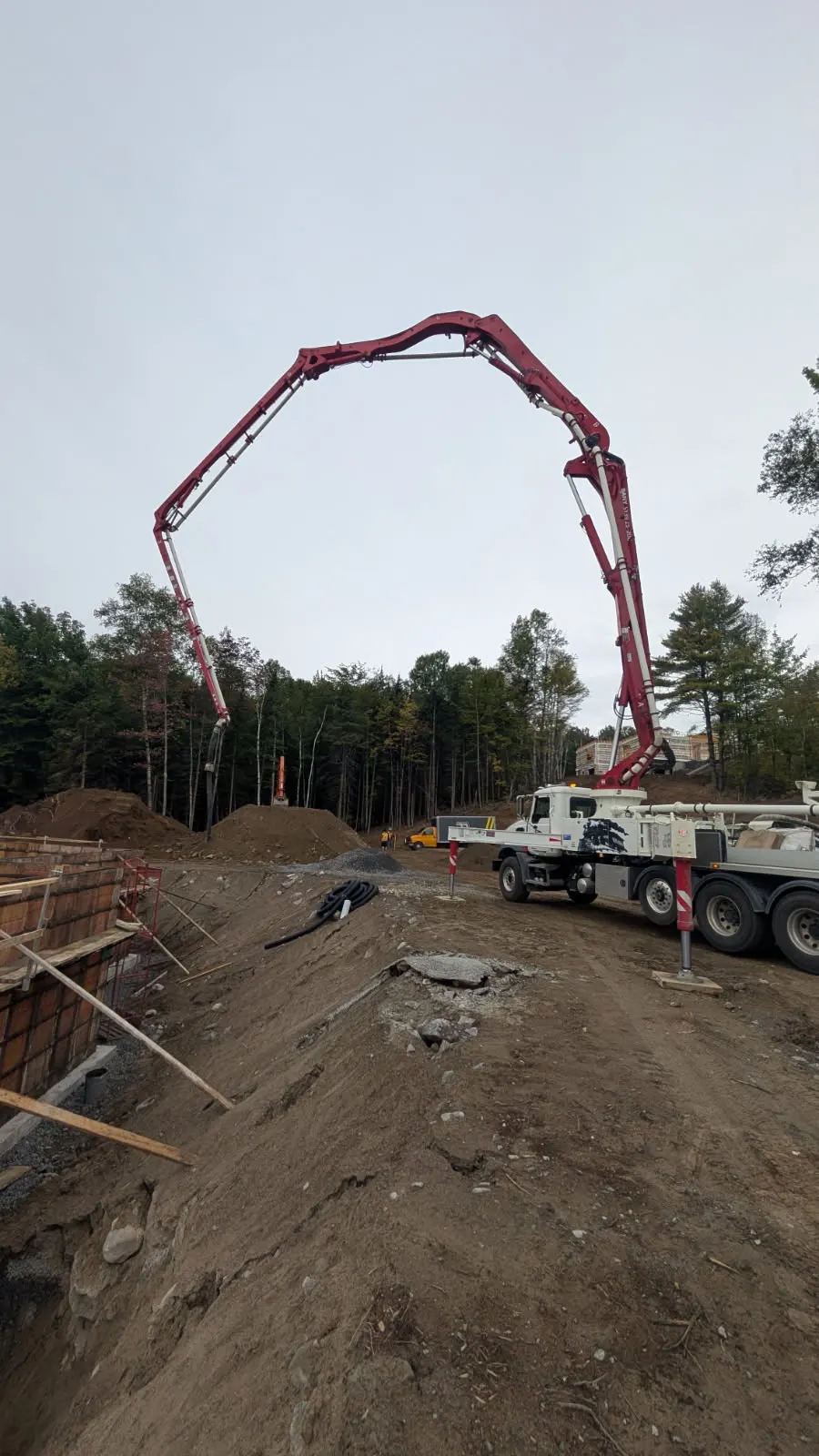
Pumping Concrete at Height: Upper Floors, Mezzanines and Roofs
Upper-floor slab, mezzanine or roof terrace: as soon as the form sits above the ground, the concrete has to climb. The pump is then chosen according to height, setback and the obstacles between the truck and the work.
Pompage de Béton Express pumps concrete at height on commercial sites, from Terrebonne to Saint-Eustache. Here is how the decision is made and what your site needs to prepare.
Four Questions That Decide the Pump
Your answers point to the right setup: a boom, or the pipeline of a line pump.
How High?
The highest point where concrete has to be placed, measured from the spot available for the truck.
How Far?
Horizontal reach matters as much as height: a form far from the edge calls for a longer boom.
Open Sky?
A boom needs a path from above; under a roof already in place, you need an opening or a pipeline.
Room on the Ground?
The truck's outriggers rest on firm ground, away from excavations and recently placed backfill.
Boom or Pipeline: How the Choice Is Made
A boom is the most direct way to raise concrete: the truck sets up on the ground, unfolds its articulated arm and places the concrete on the slab, over the edge of the building. Our booms run from 28 to 42 metres; the useful length hinges on the level to reach, but also on the horizontal gap separating the truck from the farthest discharge point.
To compare the lengths available, see our fleet.
The line pump takes the lead when a boom cannot get through:
- a mezzanine built inside a building that already has its roof;
- a floor reached only from inside, under a roof or a canopy;
- a small volume to raise, far from any truck access.
Its pipeline crosses a doorway or a bay, then climbs, securely fastened, to the form. The site assessment confirms whether this approach suits the height involved.
In Short
To pump concrete at height, you first weigh the elevation and setback of the work against the boom's reach, then check that nothing blocks its path from above. The boom, from 28 to 42 metres at Pompage de Béton Express, suits work that is open to the sky; a line pump is considered when the form sits under a roof or out of reach. In every case, the structure and its shoring are approved by the engineer before pouring.
Preparing an Elevated Slab Before Pumping
An upper-floor or mezzanine slab carries the full weight of fresh concrete before it has hardened. Before booking the pump, have the project's structural engineer confirm that the forms, the shores and the existing structure can carry that load.
The day before, check with the contractor:
- that the forms and the reinforcing steel have all been inspected;
- that guardrails are in place and slab edges are protected;
- that one person on the slab stays in contact with the operator, since the discharge point is not necessarily visible from the truck;
- that nobody can walk beneath the extended boom at ground level.
For the other work we handle on business sites, take a look at our page on commercial projects.

Upper Floor, Mezzanine or Roof Terrace: Situation by Situation
| Situation | Pump often chosen | Point to check |
|---|---|---|
| Upper-floor slab of a building under construction | Boom | Reach toward the most distant corner |
| Mezzanine inside a roofed building | Line pump | Pipeline route and fastening |
| Roof terrace | Boom | Load the roof can take, membrane protection |
| Upper-level stairs or balcony | Boom or line | Access around the building, small volume |
On a roof terrace, the concrete is added to a structure already in place: only the engineer can confirm it will accept that load. Protect the waterproofing membrane wherever people walk and the hose rests, and keep to the drainage slopes shown on the plans.
Wind matters too: a deployed boom is sensitive to it. Plan a backup date if the forecast looks bad.
Power lines near the building? Let dispatch know they are there; on our booms, eco-track makes the work safer near this kind of obstacle.
Concrete at Height: Frequently Asked Questions
How many storeys can a boom pump reach?
It depends less on the number of storeys than on the truck's possible position. The closer it gets to the building, the more reach the boom keeps for the far side of the slab. Between 28 and 42 metres, the length is chosen case by case: our guide to choosing a boom length helps you prepare the conversation.
Can you pump onto a mezzanine inside a warehouse?
In many cases, yes. If the roof is already on, a boom cannot get through, so a line pump is used instead, its pipeline entering through a large door and rising to the mezzanine. Keep a clear path for it and plan where it will be fastened. Feasibility is confirmed during the site assessment.
Should the upper floor be poured before the roof goes on?
When the schedule allows, yes: an upper floor still open to the sky is simpler to place with a boom. Raise it early with your general contractor, who sequences the trades. Once the roof is on, you will need an opening or a pipeline routed through the inside.
Do I need a permit to set up the truck on the street?
If the truck or its outriggers will occupy roadway or sidewalk space, your municipality may require one. Check with it before setting the date, and tell us in your request where you plan to place the truck.
Who confirms the slab can take the concrete?
The project's structural engineer. The engineer determines the shoring, the allowable load and, where needed, the pouring sequence. On our side, we need to know the level to reach, the setback and the obstacles to propose the right pump.

A Quote for Pumping at Height
Give us the height, the setback from the street and the timing you have in mind; Pompage de Béton Express will then draw up your personalized quote. Dispatch: 450-821-1165.