Boom Pump or Line Pump: The Right Rental for Your Site
Boom pump or line pump? The question comes up as soon as a pour is being organized, for a garage addition in Blainville as much as for an upper floor in Saint-Jérôme.
At Pompage de Béton Express, the choice starts with your site: how high the concrete must climb, the route it must travel, the room left for the truck and what hangs over the work area. This guide shows how to decide between the two.
Four Questions That Settle the Choice
Ask yourself these questions before requesting your quote.
Height
Does the concrete have to reach an upper floor or clear a roof? The articulated boom handles it from the truck.
Distance
Are the forms far from the street, behind the house? The pipeline of a line pump extends all the way to them.
Room on the Ground
A boom needs space for its outriggers; a line pump mostly needs a clear path for its pipeline.
Obstacles
Wires, branches, nearby rooftops: note them and tell dispatch about them on your very first call.
Boom Pump or Line Pump: Two Ways to Move Concrete
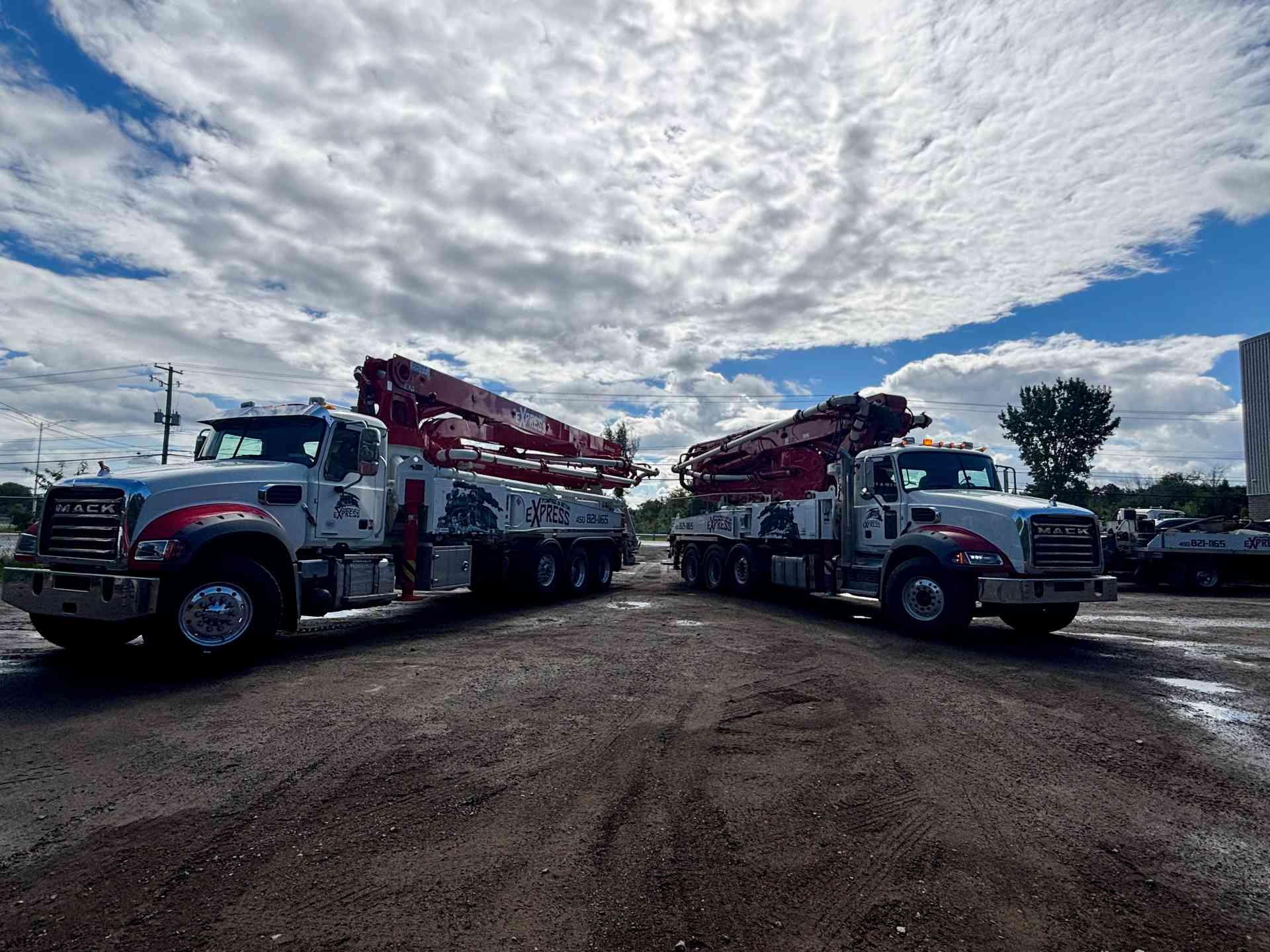
The boom pump is mounted on a truck. Once the vehicle is braced on its outriggers, the arm opens section by section and swings over the site. Concrete travels through it to the flexible end hose, which the crew on the ground guides over the forms.
Our fleet includes booms from 28 to 42 m. They earn their keep when concrete has to gain height or pass over something: a house, a row of cedars, a fence, or an excavation the truck must keep away from.
The line pump drives concrete through a pipeline stretched across the lot. That pipeline goes together one section at a time, so it can be lengthened or shortened to follow the path to the forms.
It can follow a driveway, wrap around a patio, cross a garage through its big door or drop through a basement window. It is the tool for surfaces that stretch out horizontally: slabs, floors, sidewalks, curbs. A longer pipeline works the pump harder, and the quote takes that into account.
In Short
A boom pump is the rental to choose when concrete must gain height, clear an obstacle from above or fill a foundation without the truck moving. Go with a line pump when it must cover a long distance at ground level, squeeze through a narrow passage or enter a building. If your site mixes height and distance, the Pompage de Béton Express team studies the access and names the selected pump in your quote.
When the Line Pump Beats the Boom
In the photo, the line pump waits outside the house with the mixer truck beside it. It is a typical job where concrete has to go far from the street while the trucks stay on the pavement.
A few situations where it often wins out:
- Basement slab in a renovation: the pipeline slips through a basement window, and no truck goes near the foundation.
- Backyard with no access: between two houses built close together, the pipeline follows the side passage to the patio.
- Long sidewalk or curb: the crew pours from the far end and shortens the pipeline on the way back.
- Floor under a finished roof: the pipeline crosses the rooms to the last one, where a boom can only reach through a wide doorway.
To get the pipeline route and the trucks' arrival ready, see our guide on preparing your lot for a pump truck.

The Comparison, Criterion by Criterion
| Criterion | Boom pump | Line pump |
|---|---|---|
| Concrete route | Through the air, in an articulated boom | Along the ground, in an assembled pipeline |
| Strength | Height and obstacles to clear | Distance and narrow passages |
| Typical work | Foundations, walls, upper floors | Slabs, floors, sidewalks, curbs |
| Ground needs | A stable area for the outriggers | A clear path for the pipeline |
| To mention | Wires, branches, nearby rooftops | Floors and thresholds to protect along the route |
Some projects need both, at different times. On a new house, the boom often pours the foundation walls; later, the basement gets its slab from a line pump. List every pour in your request: the equipment can differ by stage.
Others combine height and distance in the same pour. Our team then studies the site before deciding. The concrete pump rental service sums up the offer, and the Our Fleet page shows the booms available.
Choosing Between Boom and Line: Frequently Asked Questions
Can one project call for a boom, then a line pump?
Yes, it happens often in new construction: the foundation walls get their concrete from the boom, then, later in the project, the interior slab is poured with a line pump. List all your pours in the request so each one gets suitable equipment.
Can the boom reach over the house to pour in the backyard?
Yes, that is one of the things a boom is for: once unfolded, it clears the roof and comes back down toward the forms. The width and height of the house, plus the distance to the forms, decide which boom is needed. Also mention any cables running above the yard.
Which one takes up less room on a narrow street?
Generally the line pump: more compact, it sets up in less space than a boom truck, which has to open its outriggers. The mixer truck still needs to reach the hopper. In town, ask your municipality whether occupying the roadway requires a permit.
Can the pipeline of a line pump damage my property?
It simply lies on the ground and lets the mixer trucks stay on the street, so no heavy truck crosses the lawn. Indoors, the floors and thresholds along its path are protected. After the pour, it is taken apart and rinsed; plan a spot for that rinsing.
Do I need to know which pump to rent before calling?
No. Describe the work, the address, the volume to pour and what separates the forms from the street: height, distance, obstacles. Our team then recommends the equipment, boom or line, and the quote spells it out.

Request Your Quote: Boom or Line
Describe the concrete's route and the surroundings of the site, and the Pompage de Béton Express team will choose the pump with you. Dispatch: 450-821-1165.