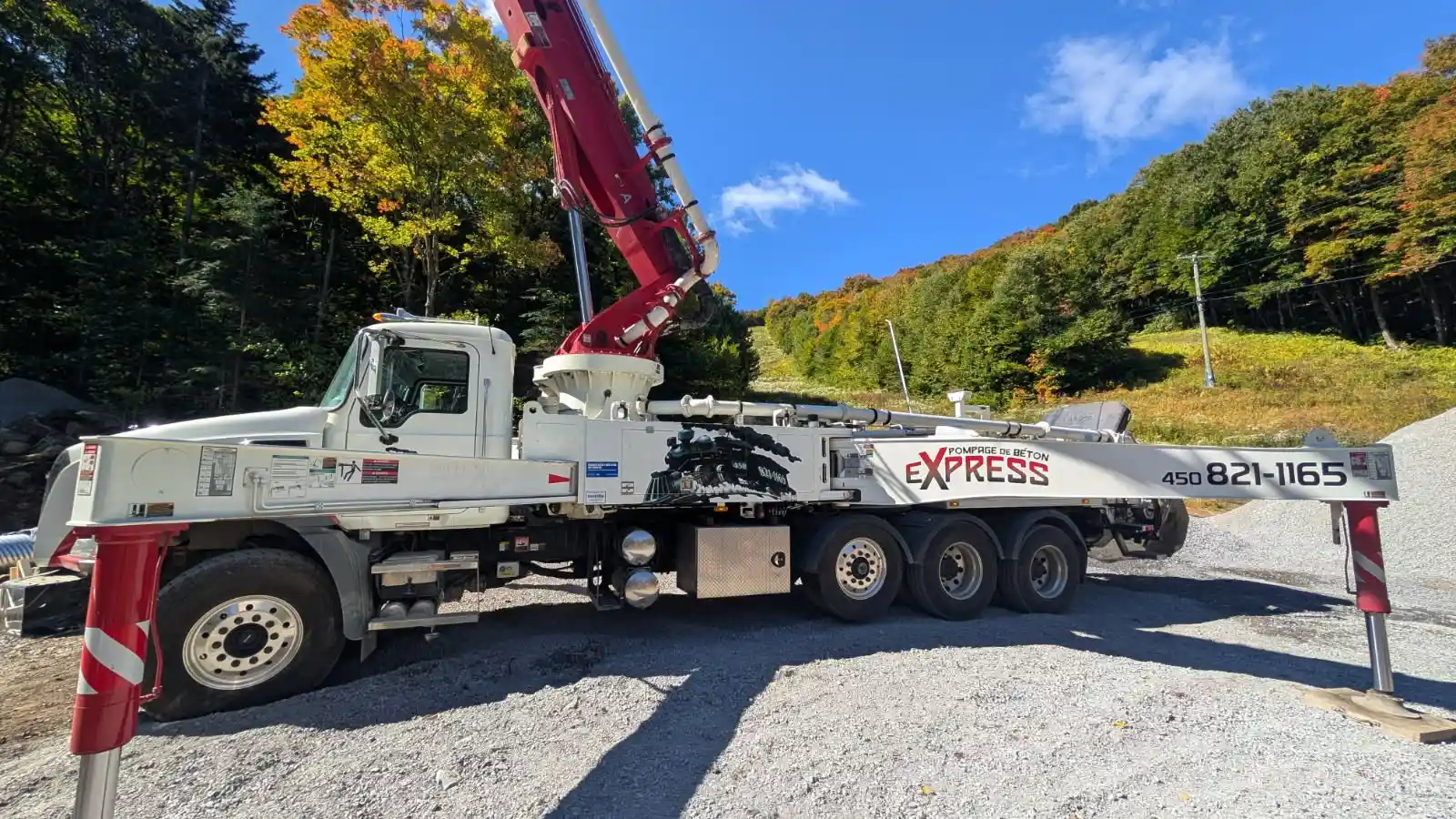
Getting Your Lot and Street Ready for the Pump Truck
A pump truck and the mixers feeding it are heavy, bulky vehicles. Much of their setup is decided well before the concrete arrives, on your lot and on your street.
From Saint-Sauveur to Mont-Tremblant, many homes are reached by a sloping or gravel road. Pompage de Béton Express lays out what to check, and when.
Four Points That Decide the Setup
Settled ahead of time, they prevent detours and waiting once the trucks arrive.
The Access Road
Width, turns, slope, low branches: the route to your home has to let a heavy truck through.
Ground Under the Supports
The outriggers rest on load-bearing ground, away from fresh backfill, a septic tank or a well.
Wires Overhead
Locate power lines and branches around where the boom will work, then mention them to dispatch.
The Street and Neighbours
A truck parked on the road or a driveway you share takes planning: neighbours told, municipality consulted.
From the Street Corner to Your Forms: Checking the Route
The route to the lot. Think about the whole trip, not just your driveway: narrow street, cul-de-sac, small bridge on a private road, steep gravel hill. In the Laurentians, a private road can also turn soft during the spring thaw or icy in winter.
If a passage seems tight, flag it for dispatch in your first call or message: we take it into account when choosing the equipment.
Choosing the truck's spot. It has to park where it can reach the forms, with room to spread its outriggers on each side. Aim for firm, fairly level ground: compacted gravel, asphalt or well-drained natural ground. Avoid the top of a septic tank, a leach field, a well or a buried line, as well as the edge of an excavation.
As for the mixer trucks, they must be able to reverse up to the hopper behind the truck and wait their turn without blocking the whole street.
In Short
To get ready for the pump truck, check the route to your home, set aside firm, clear ground for the outriggers away from the septic system and backfill, and leave the mixer trucks a way to the hopper. Tell dispatch about power lines, let your neighbours know and, if the road will be partly blocked, check with your municipality. Pompage de Béton Express assesses these points before recommending the equipment.
A Line Pump Out Front: Planning the Pipeline Route
A line pump takes up less room than a boom: it often parks out front, in the driveway or near the sidewalk, with the mixer truck right behind. Its pipeline, made of joined sections, then runs along the side of the house to the forms.
That route needs preparing too:
- clear the path along the house: bins, trailers, firewood, toys;
- note the steps, flower beds and dryer vents the pipeline will have to get past;
- leave the fence gate open if the pipeline needs to cross into the yard;
- keep children and pets inside until the pumping is done.
The pipeline is under pressure while the work goes on: nobody should step on it or move it until pumping is over.

Pump Truck Checklist: The Week Before, the Day Before, the Morning Of
| When | What to Do |
|---|---|
| When you send your request | Describe access, slope and obstacles; tell dispatch about power lines. |
| A few days before | Ask the municipality whether using the street needs a permit; warn the neighbours. |
| The day before | Move cars, trailers and materials; clear the outrigger area; remove snow in winter. |
| That morning | Open gates, keep children and pets away, assign someone to greet the trucks. |
| After pumping | Show where rinsing can be done, away from storm drains and ditches. |
On the day itself, let no one walk under the boom or near the truck while the pump is running. If something changes at the last minute, such as a car blocking the driveway or a storm, call dispatch at 450-821-1165.
These preparations apply to a foundation, a slab or a set of stairs. To see the home structures we pump, visit our page on residential concrete; the booms available are listed in our fleet.
Access and Setup: Frequently Asked Questions
Can the truck park on the street?
Often, yes, especially with a boom working over the lot. Some municipalities do require permission to occupy the public road or ask for signage: check with yours before picking a date, and give a heads-up to neighbours who park in front of your home.
My driveway has interlocking pavers: can it carry the truck?
Not necessarily. A loaded truck and its outriggers put heavy pressure on small areas, which can crack or sink pavers or this year's asphalt. Mention it in your request: the truck can sometimes stay on the street and work with the boom, or a line pump can handle the job.
Is there a risk to a septic tank or well?
Yes, if the truck or mixer trucks drive over it. A tank, a leach field or a buried line is not built for that kind of weight. Show their location in your request, and mark them off before the trucks arrive so nobody goes near them.
Do I need to be there during pumping?
It is better, or else have someone stand in for you. That person greets the trucks, shows the planned location and answers questions on site. If your contractor runs the job, agree ahead of time on who will play that role and which number to call that day.
What about winter, when the driveway is snowed in?
Clear the access, the truck's spot and the mixer trucks' path, then spread abrasive if it is icy. A snowbank can hide a curb, a marker or a septic tank lid: flag those obstacles. Measures to protect the concrete from the cold are up to your contractor and the specifications.

A Quote Suited to Your Lot
Describe the access, the ground and any obstacles near the house. Unsure where the truck should go? Call dispatch at 450-821-1165.