Concrete Pump Accessories: What They Do and How to Choose Them
A pump is only as good as the line that extends it. Concrete pump accessories, from pipes and elbows to clamps and the end hose, carry the concrete to the forms and wear a little with each job.
Pompage de Béton Express, based in Mirabel and Saint-Hippolyte, offers specialized accessories from time to time, alongside its pumps. Here is how to find your way.
The Main Families of Accessories
What links the pump to the forms, and what gets it back in shape once the work is done.
Rigid Pipes
Steel sections that make up the line; their walls get thinner as concrete flows through.
Elbows and Reducers
They change the direction or diameter of the line and take the heaviest wear.
Clamps and Gaskets
They join the sections and keep the line sealed under pumping pressure.
Cleaning Gear
Balls, catchers, scrapers and brushes: what you need to leave the line clean once pumping ends.
Concrete Pump Accessories: The Role of Each One
| Accessory | What It Does | What to Check |
|---|---|---|
| Straight pipe | Carries concrete along the run | Wall thickness, undamaged ends |
| Elbow | Goes around an obstacle, climbs or descends | Wear on the outside of the bend |
| Reducer | Steps down to a smaller diameter | Internal wear, condition of the ends |
| Clamp and gasket | Joins two sections without leaks | Firm closure, supple gasket |
| End hose | Places the concrete exactly where needed | Cover, fitting, no kinks |
A line works like a chain: its weakest link sets the pressure it can handle. Each component must therefore carry a pressure rating compatible with the pump's, and ends of the same type as the rest of the line.
On a vertical run, brackets fasten the pipe to the structure, and a shut-off valve keeps the concrete from flowing back down toward the pump when it stops. Off the job, cleaning gear completes the set: a cleaning ball, a catcher that holds it at the end of the line, plus scrapers and brushes for the hopper.
In Short
The accessories on a concrete pump, namely the pipes, elbows, reducers, clamps, end hose and cleaning gear, carry the concrete and keep the line sealed and clean. Choose them to match the pump in diameter, ends and pressure rating, suited to how you work and in good condition. Pompage de Béton Express sells specialized accessories based on availability.
The End Hose, the Part You Hold in Your Hands
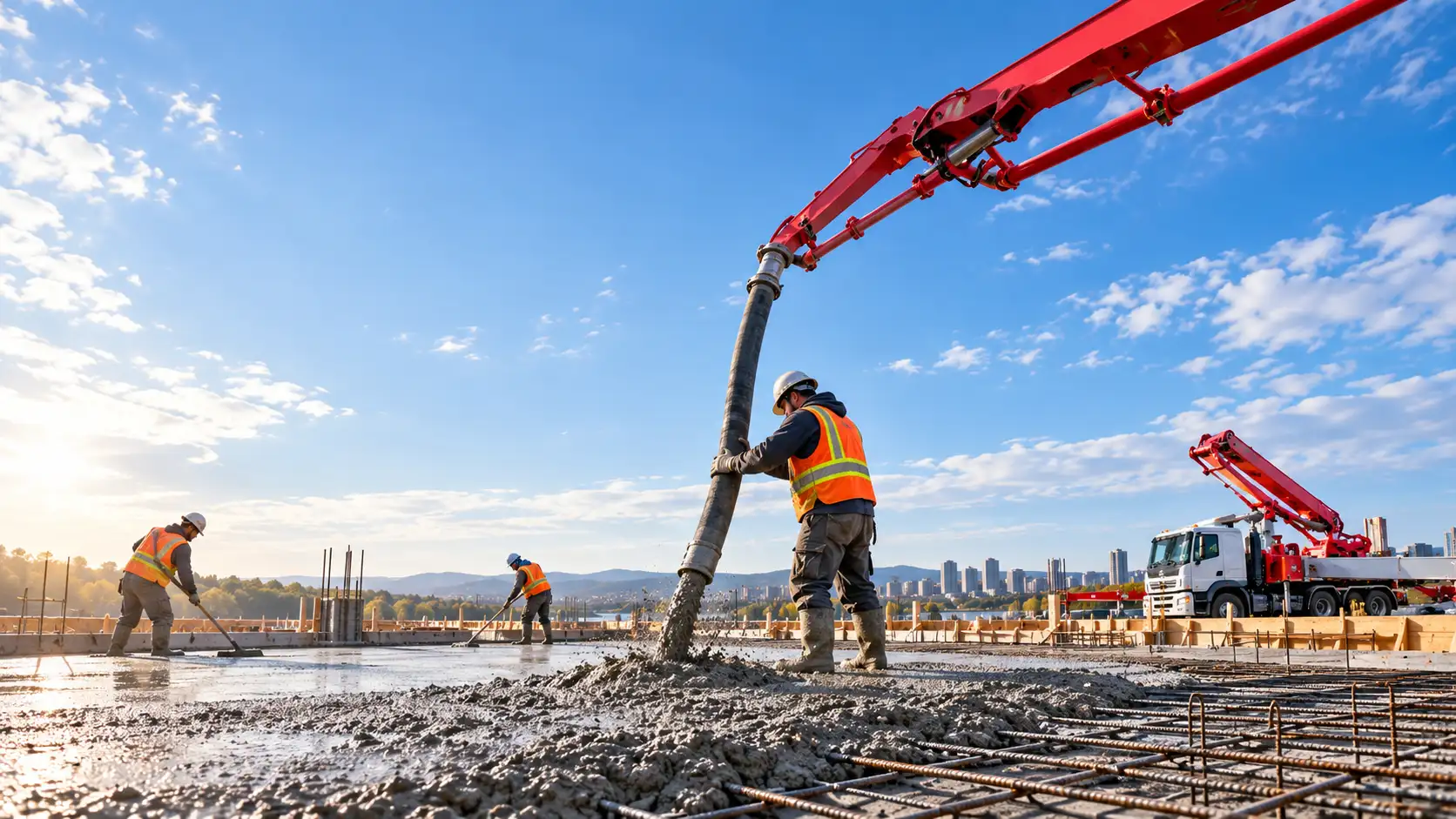
At the end of the line, the flexible hose lets the crew place concrete precisely, as on this radiant floor where the heating tubes must be spared (see our guide to pouring a large floor). It is also the most exposed accessory: it bends, rubs on the ground and gets dragged across the site between forms.
When choosing one:
- look for a length and flexibility the person directing it can handle comfortably;
- make sure its fitting matches the outlet of the line or the boom;
- pick a hose designed for concrete pumping and its pressure.
In use, avoid tight kinks, which encourage blockages. At start-up, the hose can thrash: hold it firmly and never stand in front of its outlet. On a radiant floor, carry it above the tubes rather than dragging it. Rinse it thoroughly after each use and replace it as soon as its cover shows a cut.

Choosing New or Used Accessories
Before buying, start from your pump and your job sites:
- Compatibility: the same diameter and type of ends as the pump outlet, and a pressure rating at least equal to what it develops, per the manufacturer.
- Use: a company that pumps a lot benefits from heavier-wall pipes, which last longer.
- Consistency: one clamp model for the whole line simplifies the work and the spares.
- Spares: a few gaskets, some clamps and a spare elbow keep the work from stopping.
A used accessory can be a good deal if you look at it closely. Measure pipe thickness with a gauge, turn down a dented section or one with damaged ends, and look inside the elbows. A pipe that has already held a blockage sometimes keeps the marks.
Between seasons, store the line clean, drained and capped, on racks and under cover; grease the clamps. To find out what equipment is available right now, visit our concrete pumps for sale page or phone our office at 450-971-3163.
Concrete Pump Accessories: Frequently Asked Questions
Can I mix pipes from different brands?
Yes, as long as the sections share the same diameter, the same type of ends and a compatible pressure rating. Ends that don't fit together perfectly leak under pressure and wear out the gaskets. If in doubt, compare the manufacturers' spec sheets before assembling the line.
How can I tell a pipe is too worn?
You can't see it by eye: the wall wears from the inside. Measure its thickness with a gauge at the most stressed spots and compare it with the manufacturer's minimum. Rotating the straight sections from time to time spreads the wear; an elbow wears mostly on the outside of its bend.
Which accessories should I keep as spares on site?
A few gaskets and clamps, a short section, an elbow, a cleaning ball and the tools to open the line. A failed gasket or a blockage can halt the work; with a spare part within reach, the repair happens on the spot instead of putting the work at risk.
Do I need a reducer between the pump and the line?
Only if the pump outlet and the pipe don't have the same diameter. The reducer handles the transition, but it concentrates wear and makes the pump work harder. The manufacturer specifies the intended setup; follow it rather than improvising with mismatched parts.
Is cleaning gear really necessary?
Yes. Without a cleaning ball and a catcher to recover it, the line keeps a deposit that hardens and narrows its usable diameter, leading to blockages the next time you pump. Scrapers and brushes finish the job in the hopper. It is a small investment that protects everything else.

Accessories, a Pump or a Pumping Quote?
Pompage de Béton Express can tell you which accessories are available: phone our office at 450-971-3163. Pumping to plan? Dispatch answers at 450-821-1165.